Components that
make you stand out.
React components, animations, and effects. Preview them, make them yours, and bring them into your next project.
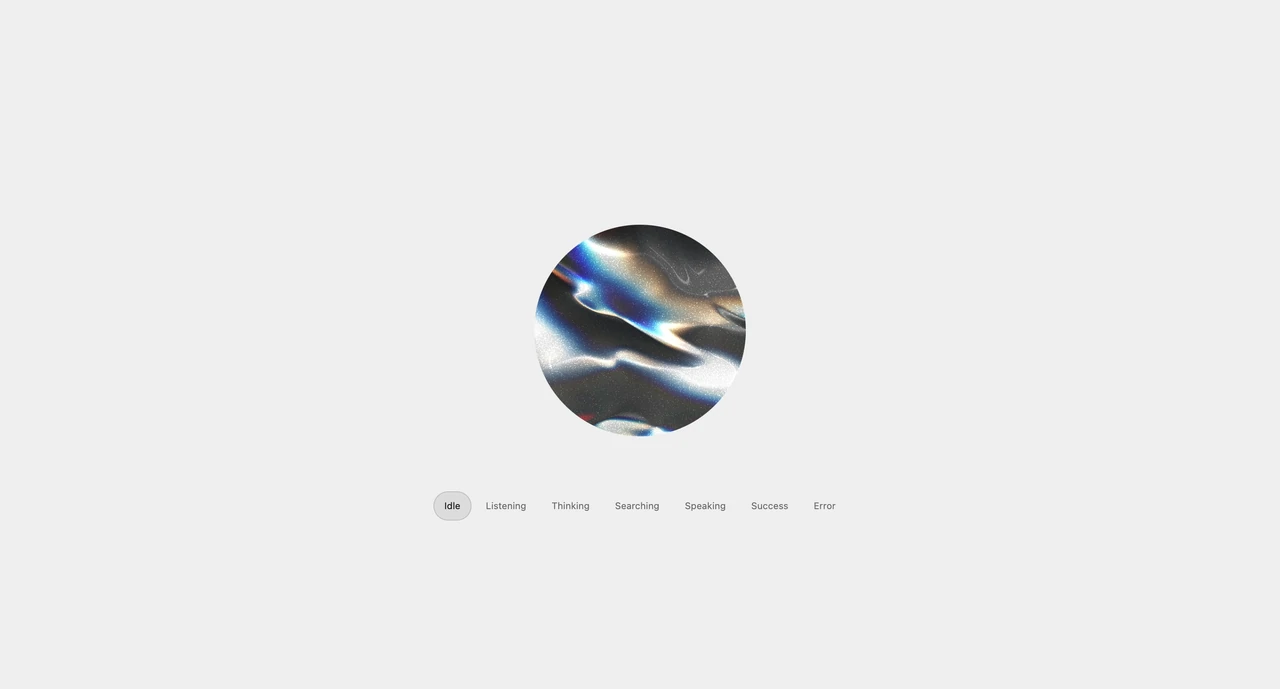
A liquid glass orb for AI interfaces, with animated agent states, voice response, customizable glass material, and six color palettes.
| Property | Type | Default | Description |
|---|---|---|---|
preset | LiquidGlassOrbPreset | monochrome | Presets apply their colors and default cluster count: 7.2 for Tide and Monochrome, 3 for the others. Azure, Indigo, Mint, Coral, Scarlet and Fuchsia preserve the current seed and playback position. Explicit props override preset values. |
state | LiquidGlassOrbState | idle | idle, listening, thinking, searching, speaking, success or error. Idle uses the original fluid glass distortion; Speaking adds a subtle voice speed boost, renews local organic wrinkles and pulses the circle. Thinking offers a two-arm spiral, concentric ripples or curved scanning folds across the entire orb, selected with thinkingAnimation. Searching offers a lens on a 45-degree tilted oval that accelerates again before each lap ends with the saved custom Bezier motion, or a small lens that moves continuously through searchingAnimation. The lens keeps moving and joins each lap with continuous velocity. Error holds a stationary cross. Other states use recognizable glass patterns with fixed material settings. |
audioLevel | number | 0.55 | Normalized microphone or assistant output envelope, 0–1. Active during listening and speaking. |
getAudioLevel | () => number | — | Sampled once per visible frame. Feed live audio without rendering React for each audio sample. |
ref | LiquidGlassOrbHandle | — | setAudioLevel(level) updates the voice envelope; reset() restarts the animation. |
animateEntrance | boolean | true | Grow from 8% to full size with power4.out over 1.2 seconds once the first frame is ready and visible. Set false to show the orb immediately. Respects reduced motion. |
thinkingAnimation | select | ripples | Glass pattern used during Thinking: a two-arm spiral, concentric ripples, or curved scanning folds. Changes blend smoothly. |
searchingAnimation | select | lens | Glass pattern used during Searching: Lens overlaps power3.out laps, starts picking up speed again at two o'clock before each lap ends with continuous forward motion; Small lens glides continuously along a rounded path with gentle changes in pace. Changes blend smoothly. |
preserveWhites | boolean | true | Keep white and near-white palette areas bright and neutral under the glass. Turn off to restore the previous color treatment. |
intensity | number | 1 | Strength of the voice response in Listening and Speaking. Changes microphone response, voice-driven size and subtle wrinkle renewal without scaling state-icon relief. |
speed | number | 1.5 | Speed of the flowing colors. Zero holds the current frame. |
flowType | select | drift | Choose a seamless morphing cycle (Drift), a circulating vortex, or rolling waves. |
distortion | number | 0.8 | Bend the glass surface into flowing folds and organic reliefs. Supports values from 0 to 8. |
animateDistortion | boolean | true | Keep the distortion points moving. Turn off to fix them at their current positions while colors continue flowing. |
clusterCount | number | 7.2 | Density of flowing glass clusters. Defaults to 7.2 for Tide and Monochrome, and 3 for all other presets. Higher values create more, smaller reliefs; zero disables the additional cluster field. Supported range: 0 to 64. |
clusterIntensity | number | 3 | How strongly the clusters contribute to the glass relief and flowing folds. Zero removes it. Supported range: 0 to 12. |
clusterSize | number | 22.5 | Scale the glass clusters while keeping folds distributed across the surface. Supported range: 0.25 to 32. |
scale | number | 0.23 | Higher values produce smaller, more numerous color pools. |
spotSize | number | 1.15 | Resize color patches within the flow. Higher values make larger patches; pattern scale and distortion stay unchanged. |
rotation | number | 0 | Rotate the gradient composition. |
seed | number | 145 | A reproducible variation of the gradient composition. |
size | number | 250 | Maximum width for a bounded shape. Background fills its parent container. |
softness | number | 0.31 | Soften the shoulders of the raised glass surface. |
relief | number | 2.94 | Height of the glass relief. Zero produces a flat surface; higher values deepen the rounded forms and their reflections. |
refraction | number | 0.65 | How strongly the raised glass displaces the flowing colors visible behind it. |
roughness | number | 0 | Low values create narrow polished reflections. Higher values spread the highlights into a frosted finish. |
reflection | number | 1.3 | Strength of the reflected studio lights. One preserves the original glass finish; zero removes reflections without changing the flow. |
caustics | number | 0 | Add light concentrations transmitted through the relief. Zero keeps the original finish; higher values reveal brighter flowing caustics. |
dispersion | number | 1 | Separate refracted red and blue color channels along the glass folds. Zero keeps the original colors. |
grain | number | 0.3 | Strength of the fine grain. Zero removes it completely. |
grainMode | select | fine | Select fine motes, larger flecks, rough texture, or monochrome noise. |
grainSize | number | 1 | Grain size in CSS pixels, consistent across screen densities. |
colorDistribution | number | 0 | Left: more color. Right: more light background. Zero uses the default distribution. Uses your Background color. |
baseColor | color | #ffffff | Color used by the procedural gradient. |
colorA | color | #000000 | Color used by the procedural gradient. |
colorB | color | #4d4d4d | Color used by the procedural gradient. |
colorC | color | #a9a9a9 | Color used by the procedural gradient. |